
Blog
6 min read
Kriyastream Introduces the "Vibe Coding Autonomy Maturity Model" for the Future of AI-Assisted Software Engineering
Why acceptable AI autonomy decreases as software matures. Kriyastream’s four-level framework from 100% experimental autonomy to enterprise assurance.
AI software engineeringKriyastream
Why AI autonomy decreases as software matures from prototypes into enterprise systems.
The software industry is entering a new phase of AI-assisted development.
What began as experimentation with vibe coding is rapidly evolving into a serious conversation about the future of engineering itself.
Founders are building MVPs in days. Developers are generating entire systems with AI coding agents. Teams are shipping software at unprecedented speed.
But beneath the excitement, one reality is becoming increasingly clear:
Not all software can tolerate the same level of AI autonomy.
At Kriyastream, we believe the industry needs a framework for understanding how AI-generated software evolves as applications mature.
Today, we are introducing the Vibe Coding Autonomy Maturity Model — a framework for understanding how human oversight, architectural rigor, and engineering discipline must increase as software systems grow in operational importance.
This model explains why applications that begin with near-total AI autonomy eventually require deeper validation, stronger governance, and increasingly deliberate engineering practices.
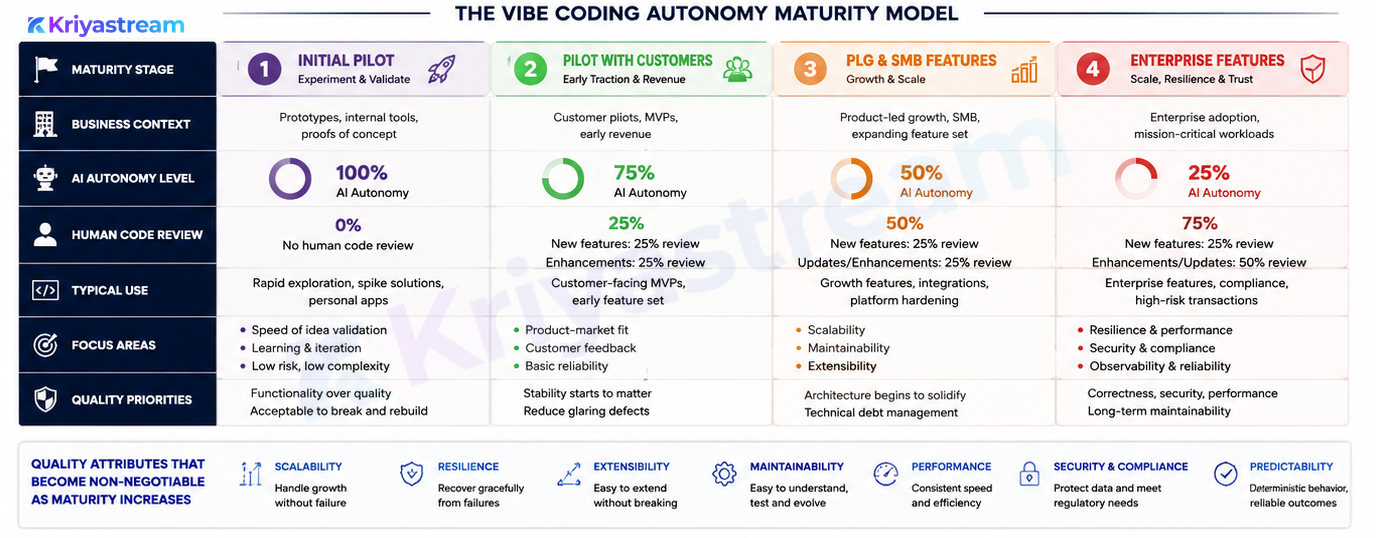
Because while AI dramatically accelerates code generation, enterprise software has never been constrained primarily by typing speed.
Enterprise software is constrained by:
- Scalability
- Resilience
- Maintainability
- Extensibility
- Operational predictability
- Security
- Compliance
- Regression management
As these quality attributes become more important, unrestricted AI autonomy becomes increasingly dangerous.
The Core Principle
The Vibe Coding Autonomy Maturity Model is based on a simple observation:
The acceptable level of AI autonomy decreases as the operational risk and lifespan of software increases.
Early-stage software optimizes for speed.
Enterprise software optimizes for reliability.
This creates a natural progression:
- High autonomy during experimentation
- Increasing human validation during growth
- Structured governance at enterprise scale
In other words:
The future of software engineering is not about replacing engineers.
It is about evolving engineering discipline around AI systems.
Level 1 — Experimental Autonomy (100% AI Autonomy)
Typical Applications
- Personal applications
- Internal tools
- Weekend projects
- Disposable prototypes
- Hackathon builds
- One-shot MVPs
Human Oversight
- Minimal or no code review
- Humans primarily validate visible functionality
- AI owns most implementation decisions
Primary Optimization
Speed.
At this stage, technical debt is tolerated because the software is either temporary, low risk, or exploratory.
The primary goal is validating ideas quickly.
This is where shallow vibing dominates.
And for many use cases, it works remarkably well.
Level 2 — Guided Autonomy (75% AI Autonomy)
Typical Applications
- Startup pilot products
- Customer validation builds
- Early revenue-generating SaaS
- Small team applications
- Internal business systems
Human Oversight
- AI generates most new features
- Humans review implementation plans
- Engineers validate major logic flows
- Enhancements receive targeted code review
- Developers begin monitoring regression risk
Primary Optimization
Balancing speed with growing product reliability.
This is the phase where teams begin realizing that unchecked AI generation can create hidden maintenance problems.
Deep prompting behaviors begin emerging:
- Asking clarifying questions before implementation
- Reviewing logs and payloads
- Narrowing remediation scope
- Requesting phased implementation plans
- Challenging unnecessary rewrites
The application is no longer disposable.
The cost of mistakes begins increasing.
Level 3 — Operational Autonomy (50% AI Autonomy)
Typical Applications
- Product-led growth platforms
- SMB SaaS platforms
- Customer-facing production systems
- Multi-team applications
- Long-lived maintained products
Human Oversight
- AI accelerates implementation but humans heavily validate changes
- New features require architectural review
- Existing feature enhancements undergo regression analysis
- Engineers increasingly own system boundaries and integration logic
- Database operations require explicit human validation
Primary Optimization
Maintainability, extensibility, and operational stability.
At this stage, teams discover the primary challenge is no longer generating code.
The challenge becomes:
- Preserving architectural consistency
- Managing technical debt
- Preventing regressions
- Maintaining performance under scale
- Isolating failures safely
- Supporting future extensibility
This is where deep vibing becomes mandatory.
The engineering bottleneck shifts from implementation speed to operational discipline.
Level 4 — Enterprise Assurance (25% AI Autonomy)
Typical Applications
- Enterprise platforms
- Financial systems
- Healthcare applications
- Regulated environments
- Mission-critical infrastructure
- Large-scale customer ecosystems
Human Oversight
- AI assists implementation but humans control architectural decisions
- New features require extensive review and validation
- Existing feature modifications undergo deep regression analysis
- Security and compliance testing become mandatory
- Human engineers validate all high-risk operational changes
- AI acts primarily as an engineering accelerator rather than an autonomous builder
Primary Optimization
Reliability, predictability, resilience, and long-term sustainability.
At enterprise scale, software quality attributes become more important than raw implementation speed.
The highest leverage engineering teams are no longer the teams generating the most code.
They are the teams best able to:
- Contain complexity
- Scale safely
- Maintain consistency across systems
- Isolate failures
- Introduce change predictably
- Support long-term maintainability
This is where deep vibing fully replaces shallow vibing.
Why Enterprise Vibe Coding Requires Isolation
One emerging reality is becoming increasingly clear:
Enterprise vibe coding will likely require stronger architectural isolation than traditional software engineering.
Why?
Because every developer — and every AI agent — introduces mistakes differently.
As AI-generated changes accelerate, systems will increasingly require:
- Strong module boundaries
- Independent deployment units
- Safer rollback strategies
- Isolated execution environments
- More deterministic integration layers
- Better failure containment
This is why patterns like:
- Module federation
- Micro frontends
- Service isolation
- Domain-driven boundaries
- Feature sandboxing
may become increasingly important in AI-assisted engineering environments.
The future developer workflow may involve multiple humans and multiple agents independently generating changes simultaneously.
Without modular isolation, regression risk compounds exponentially.
The Most Dangerous Layer: Data Operations
One area where human oversight remains non-negotiable is database mutation.
Any DML operation generated by AI should be validated by humans.
LLMs can:
- Miss edge cases in datasets
- Misinterpret foreign key assumptions
- Fail to account for partial states
- Introduce unintended destructive operations
- Incorrectly generalize update conditions
Even highly capable models can overlook subtle production data realities.
AI can assist with migrations.
But humans must validate intent.
The Future of Engineering Is Governance, Not Just Generation
One of the biggest misconceptions in the AI coding movement is the assumption that software engineering is primarily about producing code.
It is not.
At scale, software engineering becomes a discipline of:
- Managing complexity
- Containing operational risk
- Preserving maintainability
- Coordinating teams
- Validating assumptions
- Governing change safely over time
AI dramatically accelerates generation.
But generation without governance eventually creates fragility.
The future belongs to engineering organizations that can combine:
- AI acceleration
- Human judgment
- Structured planning
- Modular architecture
- Repeatable execution
- Operational discipline
This is the transition from shallow vibe coding to deep operational engineering.
Why This Matters to Kriyastream
At Kriyastream, we believe the future of work is not just autonomous AI execution.
It is structured collaboration between humans and agents.
The same principles that define the Vibe Coding Autonomy Maturity Model also define the future of work management:
- Structured task planning
- Deliberate execution
- Repeatable workflows
- Risk-aware collaboration
- Human validation before action
- Predictable operational outcomes
As the agent economy emerges, organizations will increasingly need systems that help humans and AI agents:
- Prepare structured work plans
- Validate execution paths
- Share repeatable workflows
- Track operational risk
- Reduce regression failures
- Coordinate modular execution across teams
The future will not belong to teams generating the most code.
It will belong to teams generating reliable outcomes repeatedly at scale.
That is the future Kriyastream is building toward.
Final Thought
The future of vibe coding is not binary.
It is evolutionary.
Software begins with experimentation.
But as products mature, customers grow, operational risk increases, and systems become mission critical, engineering discipline must increase alongside AI capability.
This is the core insight behind the Vibe Coding Autonomy Maturity Model.
The future of software engineering is not less engineering.
It is deeper engineering augmented by AI.