
Blog
7 min read
Asana’s AI Let Me Down: Why AI Task Lists Fail Enterprise Project Planning
I tested Asana AI on a real enterprise blog migration project. It generated a flat task list. Kriyastream generated a structured work breakdown with phases, deliverables, QA, SEO, and launch planning.
AI project managementKriyastream
AI project planning tools are everywhere right now.
Every SaaS platform suddenly has an “AI assistant” that promises to generate tasks, automate planning, and help teams move faster. On paper, it sounds incredible:
“Describe your project, and AI will generate the work breakdown for you.”
As someone building in the future-of-work space with Kriyastream, I wanted to test how real these claims actually are.
So I gave Asana’s AI a simple but realistic enterprise project:
Migrate a company blog from Blog Engine to Storyblok.
This is not an exotic project. This is a common enterprise migration initiative involving:
- Content migration
- SEO preservation
- Infrastructure updates
- QA and validation
- Cutover planning
- Stakeholder communication
- Rollback readiness
Exactly the kind of work modern AI planning systems should excel at.
The result looked promising at first.
Then everything fell apart.
The Problem With AI-Generated “Task Lists”
When I asked Asana AI to generate the work breakdown and add it to the project, it produced what initially looked like a reasonable outline.
But once the tasks were actually inserted into the project, something critical was missing:
There was no structure.
No phases. No deliverables. No work packages. No hierarchy. No dependency modeling. No execution logic.
It simply dumped a collection of disconnected tasks at the top of the project.
Here’s what Asana generated:
- Communicate launch to stakeholders
- Test all critical user flows and functionality
- Monitor site performance and error logs
- Update DNS to point to new blog
- Set up URL redirects for SEO preservation
- Verify all posts, images, and links transferred correctly
- Migrate blog content to new platform
- Backup current blog database and files
- Test migration scripts on sample data
- Configure DNS and SSL certificates
- Set up staging environment for new blog
- Audit current blog content and assets
At first glance, this might look acceptable.
But for real enterprise delivery teams, this is not a project plan.
It’s just a to-do list.
Why This Fails in Real Enterprise Environments
Enterprise work is not executed as flat lists of tasks.
Real execution requires:
- Structured decomposition
- Ownership boundaries
- Deliverable alignment
- Dependency sequencing
- Risk isolation
- Repeatability
- Governance
- Validation gates
A migration project is not:
“Do 12 things.”
A migration project is:
“Coordinate dozens of interdependent work streams across infrastructure, content, SEO, QA, editorial workflows, deployment, rollback strategy, and operational readiness.”
That requires hierarchy.
Without hierarchy:
- Teams lose context
- Dependencies become invisible
- Risk increases
- Work becomes non-repeatable
- Estimation becomes inaccurate
- Ownership becomes unclear
- AI agents cannot reliably execute the plan
This is the fundamental problem with most AI project management today.
The AI generates language.
But it does not generate operational structure.
The Same Prompt in Kriyastream
I then gave the exact same migration scenario to Kriyastream.
The difference was immediate.
Instead of producing a flat list of disconnected tasks, Kriyastream generated:
- Program phases
- Deliverables
- Work packages
- Work items
- Validation layers
- Launch readiness gates
- Rollback preparation
- Operational handoff
- QA evidence structures
- SEO migration architecture
- Integration baselines
- Security controls
- Hypercare planning
The total output expanded into more than 70 structured work items.
Not because the AI was “verbose.”
Because enterprise work is actually complex.
And complexity must be modeled correctly if teams want predictable execution.
Side-by-side: Asana vs Kriyastream
| Asana AI | Kriyastream |
|---|---|
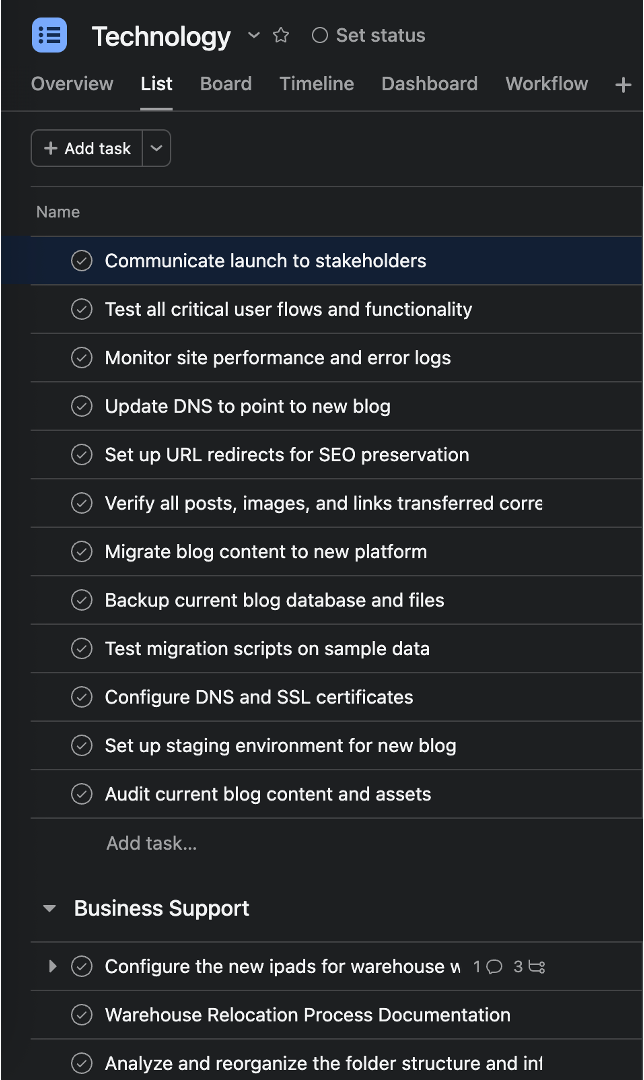 | 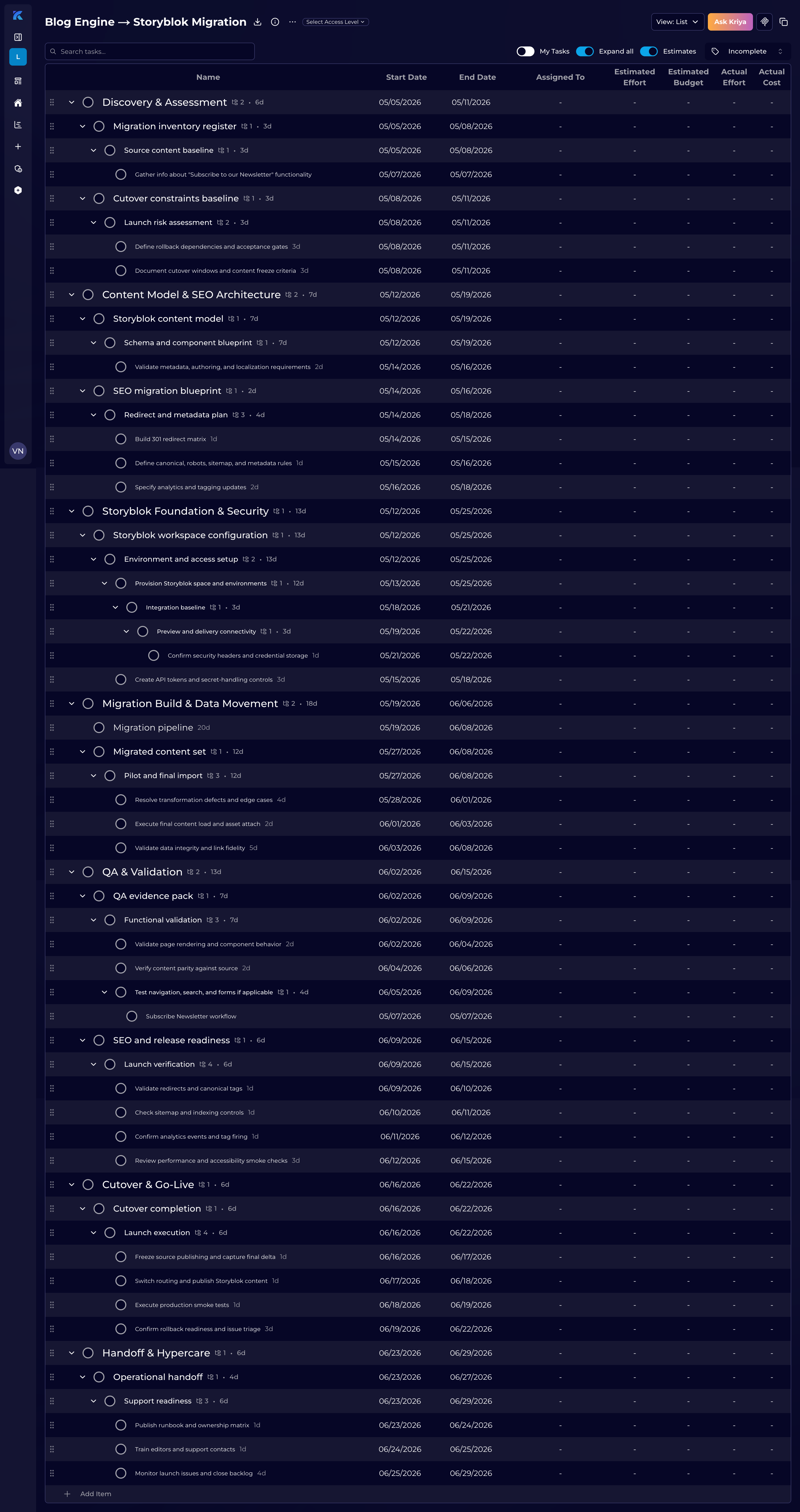 |
Left: flat tasks in Asana’s List view. Right: phased work breakdown with nested deliverables in Kriyastream.
What Enterprise Work Actually Looks Like
Kriyastream generated a deeply structured execution hierarchy.
The migration was organized into phases such as:
Discovery & Assessment
This included:
- Source content baselining
- URL and taxonomy inventory
- Media asset inventory
- Publishing workflow analysis
- Cutover constraints
- Rollback dependency mapping
This is critical because migrations fail when organizations don’t fully understand the existing system.
Content Model & SEO Architecture
Instead of simply saying:
“Set up redirects.”
Kriyastream decomposed the work into:
- Storyblok schema design
- Legacy-to-target field mapping
- Canonical rules
- Sitemap controls
- Robots directives
- Metadata planning
- Analytics updates
- Redirect matrix generation
This is how enterprise SEO preservation is actually executed.
Foundation & Security
The plan included:
- Environment provisioning
- Permission modeling
- API token management
- Secret handling controls
- Preview environment validation
- Security verification
These are often ignored in lightweight AI-generated plans, even though they’re essential for production systems.
Migration Pipeline & Data Movement
Instead of:
“Migrate blog content.”
Kriyastream generated:
- Export automation
- Data transformation logic
- Schema reconciliation
- Sample batch loading
- Pilot migrations
- Defect resolution
- Final import execution
- Asset attachment validation
- Link integrity validation
This is the difference between a task and an execution framework.
QA & Validation
This section alone was more comprehensive than Asana’s entire output.
Kriyastream modeled:
- Functional validation
- Rendering verification
- Navigation testing
- Search testing
- Pagination validation
- Preview environment behavior
- Accessibility checks
- Analytics verification
- Metadata validation
- SEO checks
- Open Graph verification
- Performance smoke tests
Because enterprise launches are not just “deployments.”
They are controlled operational transitions.
Cutover & Hypercare
This is where most AI planners completely collapse.
Kriyastream generated:
- Freeze windows
- Delta migration handling
- Production routing switches
- Smoke testing
- Rollback readiness
- Issue triage
- Runbooks
- Ownership matrices
- Editorial training
- Hypercare backlog management
This is how real enterprises operate.
AI Should Generate Operational Structure — Not Just Text
This experiment exposed something important.
Most AI project management tools today are still functioning like glorified autocomplete systems.
They generate plausible-looking text.
But enterprise work execution requires:
- Hierarchical decomposition
- Dependency-aware planning
- Repeatable task chains
- Governance boundaries
- Human + agent coordination
- Risk-aware sequencing
- Validation checkpoints
This is not merely a UX issue.
It becomes a massive operational problem once teams attempt to scale.
Especially in the emerging agent economy.
Why This Matters for AI Agents
This problem becomes even bigger when AI agents are involved.
Tools like Cursor, Windsurf, Bolt, and other AI coding agents can execute work rapidly.
But they are often non-deterministic.
Two people can give similar prompts and receive completely different outcomes.
Without a structured task chain:
- Work is not repeatable
- Results are hard to validate
- Knowledge is lost
- Teams cannot operationalize success
Kriyastream approaches this differently.
Instead of asking AI to directly execute work blindly, Kriyastream first generates a structured execution plan:
- Phases
- Deliverables
- Work packages
- Work items
- Validation steps
- Acceptance criteria
- Operational boundaries
Humans can review the plan. Agents can execute against the plan. Teams can reuse the plan. Organizations can templatize the plan.
That is how AI becomes operationally scalable.
The Real Future of Project Management
Traditional project management platforms were built for humans manually creating plans from scratch.
That made sense before generative AI.
But now we can generate structured work decomposition automatically.
The problem is:
Most platforms are still thinking in terms of tasks.
The future is not task management.
The future is:
Project intelligence.
Platforms must understand:
- How work decomposes
- How work sequences
- How work gets validated
- Which humans or agents should perform the work
- How work becomes reusable
- How work templates evolve over time
This is exactly why we built Kriyastream.
Not to generate prettier task lists.
But to create operationally accurate work structures that both humans and AI agents can execute predictably.
Final Thoughts
Asana’s AI did not fail because the generated tasks were wrong.
Many of the tasks were reasonable.
It failed because it stopped at surface-level planning.
Enterprise execution requires depth.
It requires hierarchy.
It requires decomposition.
It requires operational modeling.
And most importantly:
It requires understanding that real work is not a flat list of disconnected tasks.
As AI becomes deeply integrated into how organizations operate, the winners will not be the tools that generate the fastest checklist.
The winners will be the platforms that understand how work actually gets executed.
That is the future Kriyastream is building.
And this experiment made it painfully clear why it matters.
Watch the walkthrough
Same comparison in video form: Asana AI’s flat task list vs a structured enterprise work breakdown in Kriyastream.
FAQ
What is Asana AI?
Asana AI is an AI-powered assistant built into Asana that helps teams generate tasks, summaries, workflows, and project content using natural language.
What are the limitations of AI-generated task lists?
Most AI task generators create flat lists without hierarchy, dependencies, deliverables, validation gates, or operational structure required for enterprise execution.
What is a work breakdown structure (WBS)?
A work breakdown structure (WBS) is a hierarchical decomposition of a project into phases, deliverables, work packages, and tasks to improve planning and execution.
Why do enterprise projects require hierarchical planning?
Enterprise projects involve multiple teams, dependencies, governance requirements, risk controls, QA, and operational handoffs that cannot be managed effectively through flat task lists.
How is Kriyastream different from traditional AI project management tools?
Kriyastream generates structured work decomposition with phases, deliverables, work packages, validation gates, and reusable execution templates for both humans and AI agents.
Why is structured planning important for AI agents?
AI agents require deterministic task chains and operational context to produce repeatable, scalable, and verifiable outcomes.